Home > Main concerns about Safeguard Community Support
Main concerns about Safeguard Community Support
Safeguard Community Support presents itself as a community safety group. But there are serious concerns about its politics, its public claims, its links to far-right rhetoric, and the risks created by self-appointed patrols and reporting systems.
This page summarises the main concerns.
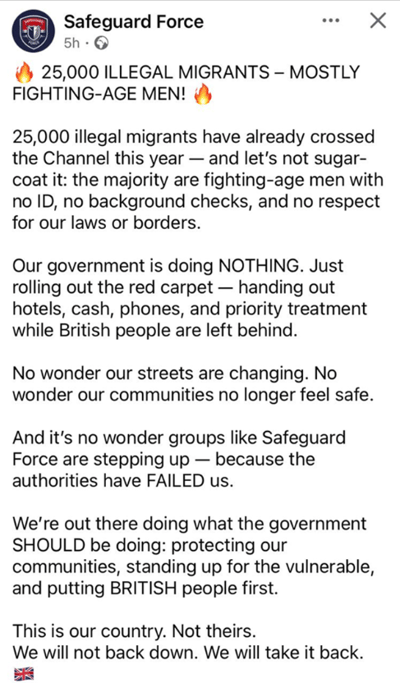
A post from the early days of Safeguard Community Support, formerly Safeguard Force.
Racism, Islamophobia and anti-migrant scapegoating in Safeguard Community Support
The most serious concern is racism. Safeguard Community Support did not appear in a political vacuum. It emerged in a climate where migrants, refugees, Muslims and asylum seekers are being blamed for social problems they did not create.
Their founder, Gary Bartlett, has close ties with racist groups in Bournemouth and is a former admin of the Islamophobic "Take Back Our Country" Facebook page. On there, he allowed the spread of misinformation and racist hate, as well as creating his own hateful posts.
Safeguard Community Support have been endorsed by Reform UK candidates like Adam Elcock and appeared on right wing media platform GB News.
While they claim to be apolitical, how can we trust they will not be influenced by their racist founders and supporters?
Racism, Islamophobia and anti-migrant scapegoating in Safeguard Community Support
The most serious concern is racism. Safeguard Community Support did not appear in a political vacuum. It emerged in a climate where migrants, refugees, Muslims and asylum seekers are being blamed for social problems they did not create.
Their founder, Gary Bartlett, has close ties with racist groups in Bournemouth and is a former admin of the Islamophobic "Take Back Our Country" Facebook page. On there, he allowed the spread of misinformation and racist hate, as well as creating his own hateful posts.
Safeguard Community Support have been endorsed by Reform UK candidates like Adam Elcock and appeared on right wing media platform GB News.
While they claim to be apolitical, how can we trust they will not be influenced by their racist founders and supporters?
A post from the early days of Safeguard Community Support, formerly Safeguard Force.
Connections with far-right politics and anti-migrant organising
A group cannot claim to be politically neutral while moving in circles shaped by anti-migrant agitation and far-right talking points.
The concern is not simply that individuals may hold right-wing opinions. The concern is that a project claiming to represent “community safety” may be influenced by politics that treat migrants, Muslims and racialised communities as threats.
Residents deserve to know who is behind the group, what their politics are, and whether the project is genuinely about safety — or about giving anti-migrant politics a more respectable local image.
Affiliation with Reform UK councillors
Safeguard Community Support calls itself apolitical, but Reform UK figures are among the most visible people linked to it. Cllr Jon Ayres and Cllr Melvyn Law have appeared on patrol with the group, former Reform candidate Adam Elcock was linked to its early coverage, and Poole’s Reform UK mayor Cllr Tracey Newman has publicly shown support.
The Vigil app and public reporting risks
The Vigil app raises a separate but connected set of concerns.
Public reporting tools can sound neutral. But in a racist society, suspicion is not neutral.
If an app allows people to report others based on subjective fear, especially around asylum hotels or racialised communities, it can amplify existing racism. It can turn prejudice into incident reports, alerts, location markers or patterns of suspicion.
Self-appointed patrols and the risk of vigilantism
Even when groups claim they are non-confrontational, patrols can still intimidate people. The presence of volunteers filming, watching or approaching people can make public spaces feel hostile, especially for those already targeted by racism, poverty, homelessness or anti-migrant politics.
Community safety should not mean unofficial groups deciding who looks suspicious.
What real community safety should look like
Real safety comes from properly funded public services, housing, youth work, domestic abuse support, mental health services, anti-racist organising and accountable safeguarding routes.
We're continually looking for new evidence. If you have public information, screenshots, statements or records relating to members of Safeguard Community Support, please get in touch.